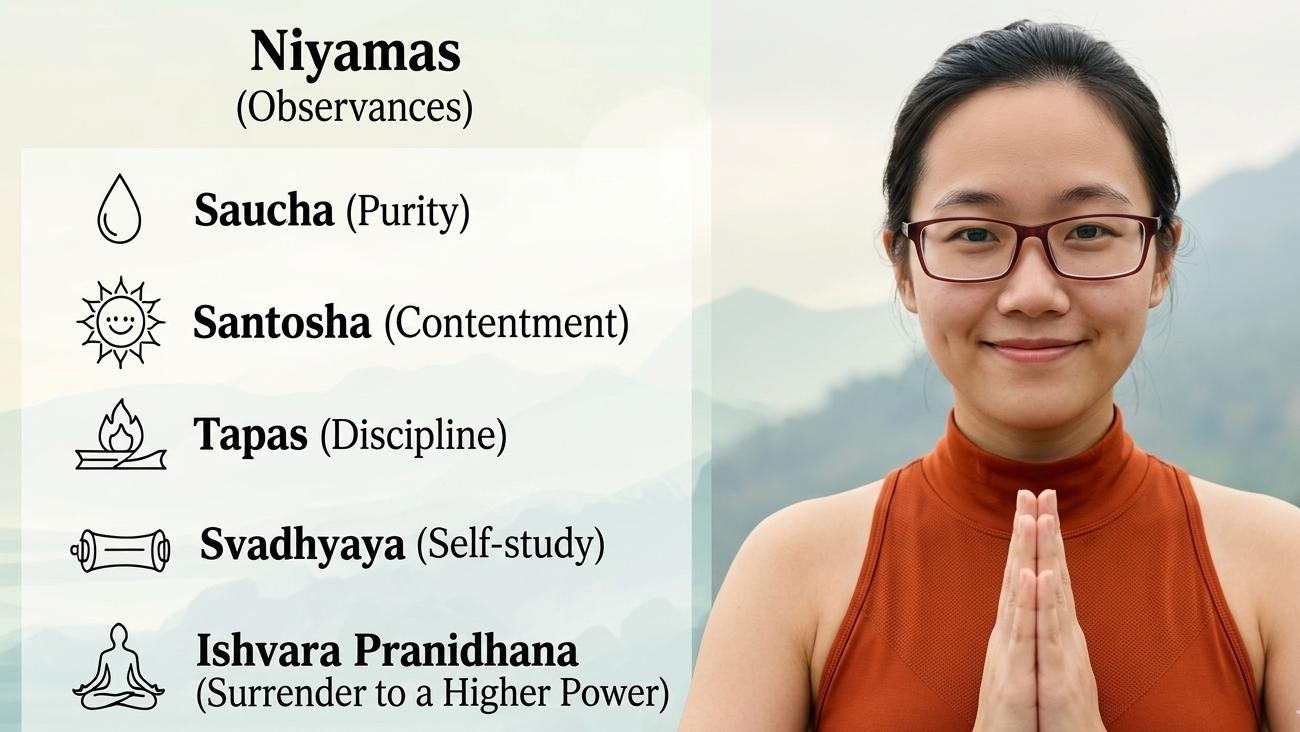
The Niyamas: Observances or Duties
 Lavanya July 26, 2024 2 min read
The 5 Niyamas
My previous post explained the Yamas which are the 1st half of the moral precepts required for meditation.
Meditation is essential in reducing the impact of the constant sensations from your body on your mind. You can think of it as putting your phone on silent mode — the phone still rings and sends you visual notifications. But it does not give any more annoying loud sounds.
It is these ‘loud sounds’ from the senses that tell you to buy glamorous clothes, eat delicious food, and get the fastest cars. All of these expensive things enslave the mind and make it selfish.
If the 5 Yamas tell what to avoid in order to increase the desire to meditate, then the 5 Niyamas tell what to pursue.
1. Shaoca (Purity)
This imposes on us to clean ourselves, both body and mind. This prevents bodily diseases and also mental diseases such as materialism, lust for power, tendency to belittle others (or conversely, to have inferiority complex), etc.
2. Santosa (Contentment)
This imposes on the mind to love what one already has. While asteya and aparigraha rein in the mind to prevent it from developing desires, santosa imposes one to find happiness in the ordinary things in life.
3. Tapah (Austerity)
This imposes on the mind to absorb the pain and suffering of others.
This is the exact opposite of egoism wherein you are separate from the suffering that other people feel.
Why would anyone do something so counter-intuitive and absorb the suffering of others?
This is because it is closer to the True Nature of Reality where everything and everyone is a single entity or unit in the mind of the Supreme Entity.
For atheists who are allergic to the idea of God, the idea of a Supreme Entity can be replaced with the idea of a huge supercomputer that runs a single program in its memory. In this way, the universe is one big app which all use the same computational and memory resources. Removing the garbage from one process will make all processes and therefore the whole app run better. If no process did garbage collection, then the app would be forever slow.
4. Svadhyaya (Self-Study)
This imposes on the mind to study spiritual works such as the Yoga Sutras of Patanjali, the Buddhist writings, the Bhagavad Gita, etc.
Since those works were written by higher-frequency minds, then those who read them will also adopt that higher-frequency pattern in order to understand what those works mean. Most often, some stay in the lower frequency and this leads to competing interpretations of the same work.
This is more common in Judeo-Christianity wherein different groups have competing interpretations of the Bible and the Quran. This is because, unlike Hinduism, Buddhism, and Taoism, they do not have a systematic approach to developing mind and ego in the first place.
5. Isvara Pranidhana (Surrender to Supreme)
This imposes on the mind to surrender one’s ego to the Supreme Entity (Isvara). This is the final part and climax of Yama and Niyama. By surrendering oneself to the Supreme, then the ego is harmonized with the flow of the Universe.
Some spiritual systems are aware that the ego is the cause of problems. And so they try to destroy the ego through extreme suffering and hardships.
But in yoga, the ego is not destroyed. Instead, it is given to the Supreme and aligned with It.
Unlike Christianity wherein devotees crucify themselves to mimic Jesus, or hurt themselves with spikes (such as in the Opus Dei), yoga does not impose self-harm (this is also in line with ahimsa).
This Niyama is the entry point to the next phase which is meditation. In fact, meditation, as sadhana or spiritual practice, is an implementation of Isvara Pranidhana.
In other words, if Isvara Pranidhana is a precept or rule, then sadhana is the actual rule-enforcement or physical implementation of that rule.
Yoga Hoa Sen
Lavanya